About this game
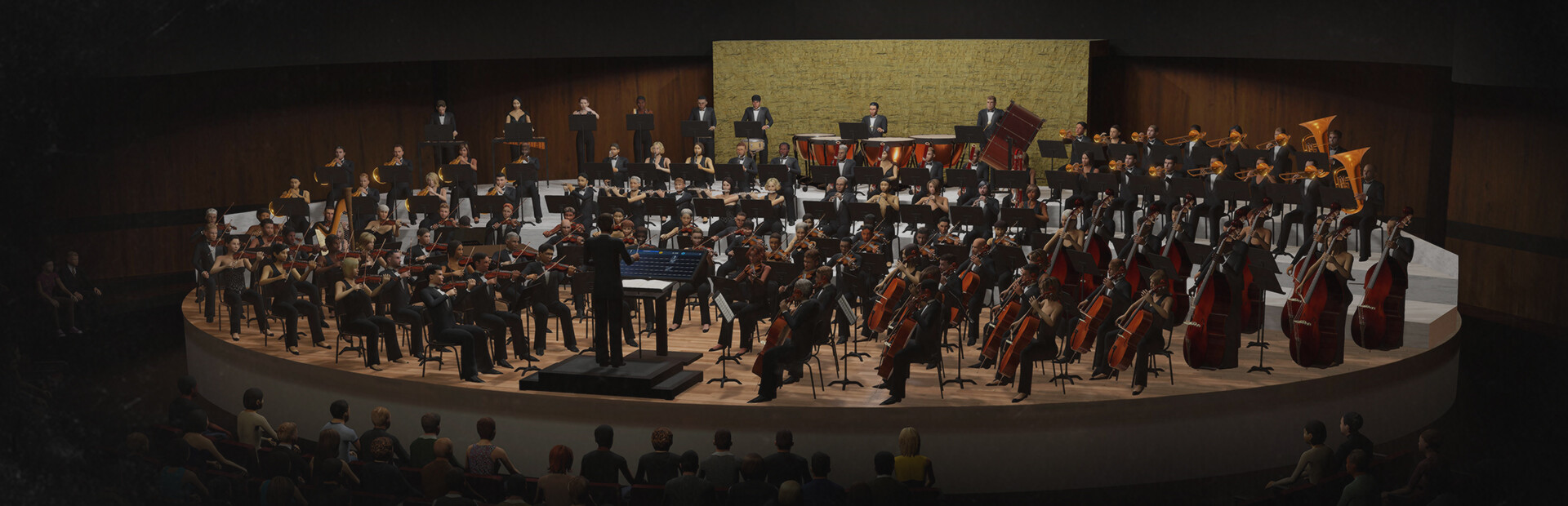
YOU ARE THE CONDUCTOR Maestro VR tracks both of your hands independently, and neither one is locked into a job. A hand can carry the beat, call in a section, swell a crescendo, or hold the whole orchestra on a fermata with a closed fist. It can also do nothing at all while the other works, or mirror the same pattern alongside it. That is how conducting actually behaves, and it is how it behaves here. Every gesture means something musically — nothing is decorative. As rigorous as you want it. As accessible as you need it. THREE WAYS TO PLAY • Rehearsal — No audience, no money, no pressure. Mute entire sections (strings, woodwinds, brass, percussion, choir) to work on just one part, and turn on the metronome. You must rehearse a piece before you premiere it, exactly like real life. • Performance — The real thing: a paying audience, ticket revenue, critics and your reputation on the line. If the orchestra loses confidence in you, the concert falls apart. • Pro Performance — For conductors who already own the baton. Far more density, none of the visual aids. And one switch that changes everything: screen on or screen off. With the stage screen on, a large display guides you. With it off in Performance, the cues float in 3D space around you — the purest rhythm-game feel. With it off in Pro, there is nothing at all. Just you, the orchestra, and your memory. A LIVING ORCHESTRA • 38 instruments and voices — full strings, woodwinds, brass, percussion and choir. • Up to nearly 100 musicians on stage at once, each playing their own part. • They really play: bows rise and fall, fingers slide along the fingerboard, vibrato, pizzicato, col legno, tremolos, mallets alternating hands and striking harder or softer with the music. • They look at you. Their eyes move between the score, your baton and the audience. • They react to your mistakes. A badly cued musician loses focus, stops playing and takes time to recover his confidence. You will hear it. • The final bow: after a great concert, point at the concertmaster with your hand and raise the entire orchestra to take the ovation. It only happens if you do it. EVERY HALL IS A DIFFERENT CHALLENGE Every venue has its own acoustics, reverberation, capacity and economics — from an intimate chamber room to a great symphonic auditorium. When a piece fits more than one hall, you choose where to premiere it, and with it you choose your rent, your risk and your reward. The audience is real: as many people are physically seated as you managed to attract. Layered applause that grows with the crowd, a standing ovation that spreads like a wave from the front rows to the back of the house — and booing, if the concert collapses. BUILD A CAREER You start as an aspirant with a cheap baton and no money. Everything else you earn. • Experience points for every gesture you land, with streaks, multipliers and bonuses. • Honorary ranks that track your career: Aspirant, Assistant, Associate, Principal, Maestro, Resident, Emeritus. • A 0-to-5 star reputation that rises and falls with your concerts and your reviews. And beware — the more famous you get, the more your musicians charge you. • Four musical notes per piece: complete the rehearsal, the performance, the Pro performance, and finally Virtuoso — a flawless interpretation without a single mistake. Each note can be upgraded from Cyan to Green to Gold. THE TALENT TREE Almost 50 talents across three specialisations, five tiers deep, with mutually exclusive paths and a mastery talent at the end of each branch: • CONDUCTING — rhythmic precision, timing windows, fermata control, consistency multipliers and stamina. • LEADERSHIP — easier cues, section trust, shields that absorb a mistake, higher income and better reviews. • EXPRESSION — dynamics, accents, expressive range, graceful recovery and standing ovations. Passive talents, active techniques you equip in two slots and fire mid-concert with the controller buttons, trade-offs that give you more power in exchange for more demand, and mastery talents that change how you conduct entirely. Respec freely and try a different build for every piece. CONDUCTING IS ALSO A BUSINESS Before a single note is played you must decide how you are paying for this concert. • Self-financed — you pay every cost up front. If it goes well, the profit is entirely yours. If it doesn't, that money is gone. • Patron — you pay nothing, but he takes half the earnings. Fail him and his cut climbs to 60%, 70%, up to 75%, until you deliver a success again. With a patron you cannot run an advertising campaign. • Advertising campaigns in four tiers. More investment, more people in the hall — but publicity is not an exact science. Some nights it overperforms, some nights it doesn't, and the report tells you exactly what it achieved. Afterwards you get a full financial report, written in plain language: attendance rate and real headcount, hall rental, musicians' wages, advertising cost, gross revenue, bracketed taxes (highly profitable concerts pay a success surcharge), the patron's share, and your net profit. There is an efficiency bonus if you conducted a piece with fewer musicians than the hall usually requires — and a break-even point below which you lose money no matter how well you conducted. Filling the seats is part of the job. Then the critics publish. Several reviewers write about your concert and your reputation moves accordingly, broken down star by star. COLLECT, BUY AND EQUIP • Dozens of batons in five rarities — Common, Uncommon, Rare, Epic and Legendary. • Every baton has its own ability, either passive or an active technique with its own cooldown. • Many are tied to a musical era — Renaissance, Baroque, Classical, Romantic, 20th and 21st century. When you pick a piece, the game equips and unequips the matching ones automatically, so choosing your baton is part of preparing the concert. The finest ones work in any era. • Buy several copies of the same baton to keep it ready on different stands,…